

The Highest-Performing Women Are Hitting an Invisible Wall
Women hold 42% of all jobs but only 24.6% of C-suite roles and 19.1% of CEO roles, what the World Economic Forum’s 2026 report on closing the gender gap in senior leadership calls the “drop to the top.” Representation isn’t holding steady while the pipeline catches up, either. IMD’s January 2026 research found women’s executive representation had fallen below 31% heading into this year.
The glass ceiling framing captures something real. But it’s an incomplete diagnosis; it describes a barrier sitting above women, and it misses the gap that opens up inside the transition itself, after the promotion happens.
Look at where women do reach senior roles, and a pattern shows up: 66% of CHROs are women, compared to 8.6% of CTOs. Women are advancing through functional and expert excellence — and then stalling in exactly the roles that demand something other than expertise. Read more about the broken rung that creates this pattern lower in the pipeline.
To see what that “something else” is, you have to look at what these roles actually change.
What Is Leadership Identity and Why It Beats Skills
“Leadership is an identity as much as it is a set of skills,” write Cunningham and Ashford of Michigan Ross, and that framing is the hinge this entire post turns on. Leadership identity isn’t a soft add-on to leadership competence. It’s a separate, measurable thing: whether someone sees themselves as a leader, and whether the people around them see and validate that claim too.
That claim-and-validation process isn’t solitary. Researchers Ely, Ibarra, and Kolb describe it as a claiming-granting cycle: identity is built relationally, through repeated moments of claiming a leadership stance and having others grant it. And this is precisely where second-generation gender bias does its quiet work: the granting side of that cycle is measurably harder for women, independent of their performance.
That’s what produces the Leader-Identity/Competence Paradox: qualified, high-performing women are less likely to internalize a leader identity than equally qualified men, and this gap persists after the promotion. The title updates immediately. The self-concept doesn’t. She’s competent in the role well before she believes she belongs in it.
One distinction worth making explicit, because at least one competitor in this space collapses it: leadership identity is not the same as your leadership brand. Brand is external packaging: how you’re perceived, positioned, communicated. Identity is the internal self-concept underneath it. You can polish someone’s brand for a year and never touch their identity.
This is why the standard development playbook keeps underdelivering for women.
Why Leadership Training Fails Women: The Reversion Effect
Harvard Business Review named the pattern a decade ago without naming the mechanism: “people soon revert to their old ways of doing things” after leadership training ends. A CEB survey cited in that same piece found 75% of senior managers dissatisfied with their organization’s leadership development function. The industry has known something was broken for ten years.
Here’s the mechanism: under pressure, leaders default to their most deeply held identity. For a high-performing woman newly in a leadership seat, that identity is the expert who earned every previous promotion by outperforming, out-preparing, and out-executing everyone around her. We call it the Reversion Effect, the snap-back to a proven identity whenever a new, unvalidated one is put under real stress.
The gendered version of this is well documented and rarely connected to the training conversation. Ibarra and Petriglieri’s research on identity transitions found that under identity threat, women rationally adopt protective strategies like over-preparing, leading with data, letting results speak for themselves. These strategies look like execution. They function as retreat. And they delay the identity transition while compounding the very threat they’re meant to manage.
There’s an added layer specific to this transition. She’s often now leading former peers, frequently men, often in a male-dominated function, where a credibility tax makes retreating into expertise feel like the only safe move. Delegating reads as risk. Over-preparing reads as safety. Out-executing everyone is the exact strategy that has answered every doubt raised about her, for her entire career. Under current systemic conditions, reverting to the expert identity isn’t a personal failing. It’s the path of least resistance.
Which is exactly why skills-first programs can’t fix this. They train new behaviors on top of an unchanged identity, and under pressure, the identity wins.
Which reframes what the expert-to-leader transition actually requires.
The Difference Between an Expert and an Influential Leader
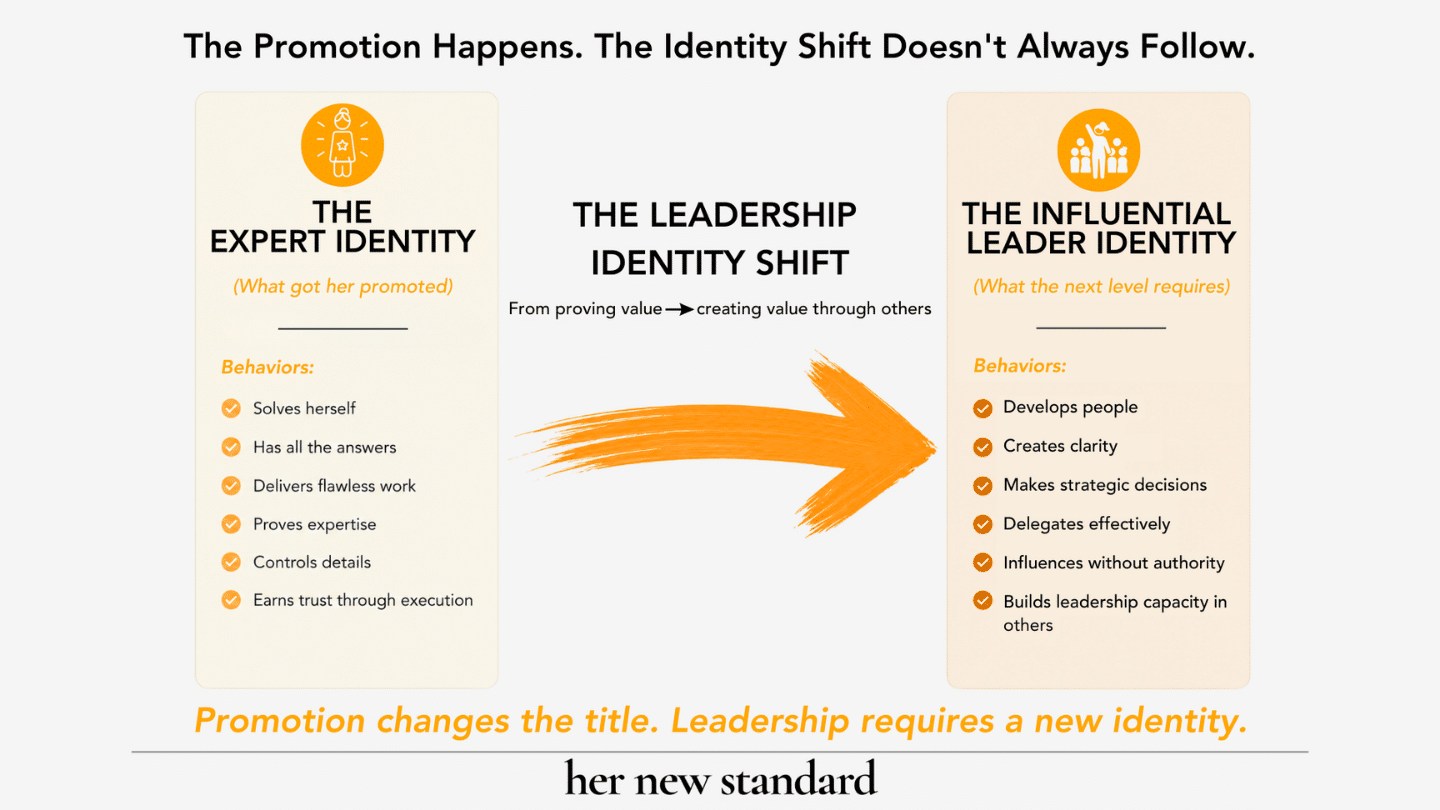
Here’s the contrast, stated plainly: experts are valued for what they know and produce. Influential leaders are valued for what they make possible in others. Expertise scales by doing more. Leadership scales by developing people, shaping strategy, and leading with influence rather than execution.
That’s not a promotion step. It’s an identity chasm because the exact behaviors that earned every prior success are the ones that now hold her back. Call it the High Potential Trap: the strategy that got you here actively prevents you from getting to what’s next, and nobody warns you that the switch has to happen.
If the transition is an identity shift, development has to be built to produce one.
What Organizations Can Do: Identity-First Development
Start with the concession, because it’s true and it matters: systems fixes are necessary. Gender-balanced succession slates, clearly defined feeder roles, and measured sponsorship, what IMD calls the Power Triad, genuinely widen the path into senior leadership. WEF’s own four-pillar redesign points in the same direction. None of that should be argued away.
It’s also insufficient on its own. WEF’s 2026 data shows women CEOs hold their seats for an average of 3.7 years, against 5.2 years for men — a gap the research presents without explanation. Here’s the interpretation the data supports: getting there is a systems problem. Staying there, and expanding what the role can do, is an identity problem. A redesigned pathway still needs a leader whose identity holds once she’s standing in the role.
That’s what identity-first development is built to do, and it follows a specific sequence:
- Surface the operating identity — 360-degree feedback and coaching that make visible which identity (expert vs. leader) someone is actually operating from, not just which title they hold.
- Create the conditions for the shift — a peer cohort functioning as what Ely, Ibarra, and Kolb call a holding environment: a space safe enough to practice claiming a leader identity before it feels fully earned.
- Embed it over time — sustained coaching, not a single event. Identity doesn’t shift in a workshop; it shifts through repeated, supported practice under real conditions.
- Measure it months later — behavior change at 12+ months, not satisfaction scores at completion.
In the programs we run, that sequence produces results that hold: 82% sustained behavior change at 12+ months, a 9x promotion rate against baseline, and 95% three-year retention among participants. Sponsorship works alongside development in this model too — it’s a necessary complement, not a substitute, and it deserves the case for investing in women’s leadership development in its own right.
Which gives you a sharper set of questions for any program you’re evaluating.
How to Evaluate a Development Program for Your Women Leaders
Most program pitches sound similar on the surface. These questions tell you what’s actually underneath one:
- Is it sustained or episodic? Sustained coaching beats one-off training because identity change doesn’t happen in a single session. Instead, it happens through repetition over months.
- Does it measure behavior change at 12 months, or satisfaction at completion? A high completion-survey score and a durable identity shift are two different things, and only one of them is visible on day one.
- Does it do identity work, or skills transfer? Ask what the program changes about how someone sees themselves, not just what it teaches them to do.
- Is there a peer cohort, or a classroom? A holding environment where claiming a leader identity feels safe is structurally different from a room of individuals absorbing content.
- Is it built for the specific dynamics women navigate — the double bind, the harder granting side of the claiming-granting cycle, or is it generic leadership content with a women’s label on it?
One more filter, borrowed from MIT’s critique of the training industry: hours logged and satisfaction scores are not outcomes. If a program can’t tell you what changed a year later, it’s measuring the wrong thing.
The Question That Changes the Conversation
Go back to the woman from the opening. The question was never whether she could earn the role. She did. The real question is whether anything in your development approach is designed to change who she believes she is, now that she’s in it.