

Where the Leadership Pipeline Breaks Down
The idea of the “leadership pipeline” suggests a steady, predictable progression from entry-level roles to senior leadership. But in reality, that pipeline is far from linear.
As highlighted in our earlier work on the broken rung, the first major barrier often appears early, when women are less likely to be promoted into their first management roles.
But what’s less discussed is what happens next. Mid-career, often between the ages of 35 and 50, is where many women find themselves with deep experience, proven performance, and the readiness to lead at the highest levels. And yet, this is often where advancement slows.
The Women in Leadership: An Industry-Level Quantitative Analysis (2025) describes this as part of a broader “leaky pipeline,” where women’s representation diminishes at each step of the hierarchy due to cumulative structural barriers, cultural expectations, and uneven access to opportunity. Research shows that even at the manager level, the early stages of mid-career, women are promoted at lower rates than men: only 93 women are promoted to manager for every 100 men, creating an early gap that compounds over time.
In other words, the pipeline doesn’t just leak early. It narrows over time.
The Mid-Career Inflection Point
There is something powerful and often overlooked about women in their 40s and 50s.
At this stage, many leaders bring together decades of experience, strategic clarity, and a level of confidence that can’t be taught in a training program. This is often when leadership potential is at its peak. And yet, it is also a moment shaped by complexity.
Some women have taken career breaks or reduced roles due to caregiving responsibilities. Others have navigated non-linear paths that don’t fit neatly into traditional leadership trajectories.
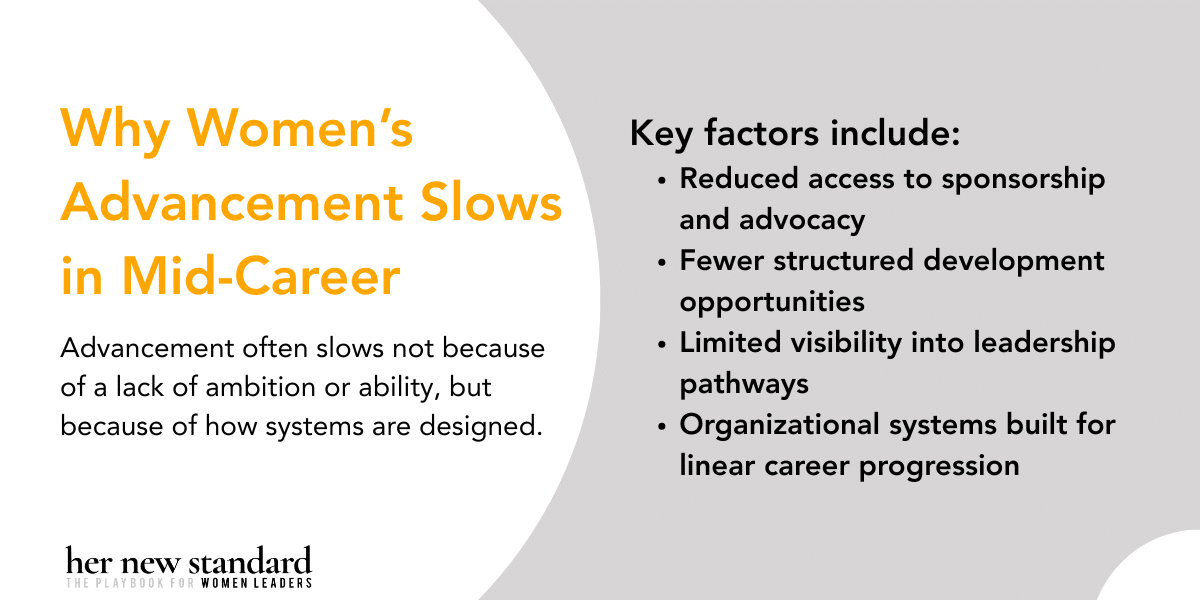
But most organizational systems are still designed around uninterrupted, linear advancement. The result is a disconnect: experienced, capable women who are ready to lead but are not always seen, positioned, or sponsored accordingly.
This is where ambition meets friction.
The Sponsorship Gap
One of the most significant and least visible drivers of leadership advancement is sponsorship.
Unlike mentorship, which focuses on guidance and advice, sponsorship is about advocacy. Sponsors actively open doors, recommend individuals for opportunities, and use their influence to shape career trajectories.
And the data is clear: this matters. McKinsey research shows that employees with sponsors are promoted at nearly twice the rate of those without. Yet women, particularly women of color, are less likely to have access to sponsors at the most critical points in their careers.
This is a reflection of access, not capability. Without sponsorship, even the most qualified leaders can find themselves overlooked for stretch roles, succession pipelines, and executive visibility.
The Investment Drop-Off in Mid-Career
Most organizations invest in leadership development, but not consistently across the career path.
Early-career employees often receive training and onboarding support to build foundational skills, while more senior leaders are typically selected for executive programs and targeted development.
It’s the mid-career stage, when leaders move from manager to director, that is often underinvested.
For many women leaders, this is where the gap becomes visible: fewer structured development opportunities, less consistent coaching, and limited access to sponsorship. Yet this is precisely the stage where investment could have the greatest impact. Mid-career is where leadership identity is solidified, where confidence is either reinforced or eroded, and where visibility and sponsorship determine whether a leader continues to rise or begins to plateau.
When organizations pull back at this stage, they unintentionally create a gap between potential and progression.
Why This Matters for Organizations
This is as much a business imperative as it is a gender equity issue. Organizations that fail to sustain strong leadership pipelines risk losing experienced, high-impact leaders at the very moment they are most valuable.
Research from McKinsey & Company shows that when women lack access to sponsorship, visibility, and advancement opportunities, particularly at mid-career, they are more likely to stall in their progression or leave organizations altogether.
This stage is especially critical. Mid-career is where leadership trajectories are shaped, and where the absence of investment can quietly redirect otherwise high-potential talent.
When women stall, organizations lose more than talent. They lose perspective, resilience, and leadership capacity that cannot be easily replaced.
A Closer Look: How Systems Shape Leadership
The data is only part of the story. The other part is how leadership is defined and evaluated.
Organizational cultures often privilege independent leadership traits like assertiveness, decisiveness, risk-taking, while undervaluing communal traits like collaboration, empathy, and participatory decision-making.
These biases don’t just exist in theory. They are embedded in competency models, performance reviews, and promotion criteria. And because women are more often associated with communal leadership styles, their contributions can be undervalued, even when they are highly effective.
This creates a subtle but powerful disconnect between how leadership is performed and how it is recognized.
The Role of Leadership Development
If ambition is not the problem, then what is the solution?
Leadership development, when done intentionally and at the right stages, can be one of the most effective levers for change. Not generic training. Not one-size-fits-all programs. But targeted development designed to support women leaders through critical inflection points, especially in mid-career.
At Her New Standard, we’ve seen that when women are given the tools, support, and sponsorship they need at this stage, they lead differently: more strategically, more confidently, and with a deeper sense of impact. And their organizations reap the benefits.
You can explore more on our approach at leadership development for women.
Why We Need to Rethink the Conversation
The question is no longer whether women remain ambitious. It is whether organizations are prepared to meet that ambition with the access, investment, and support it requires.